
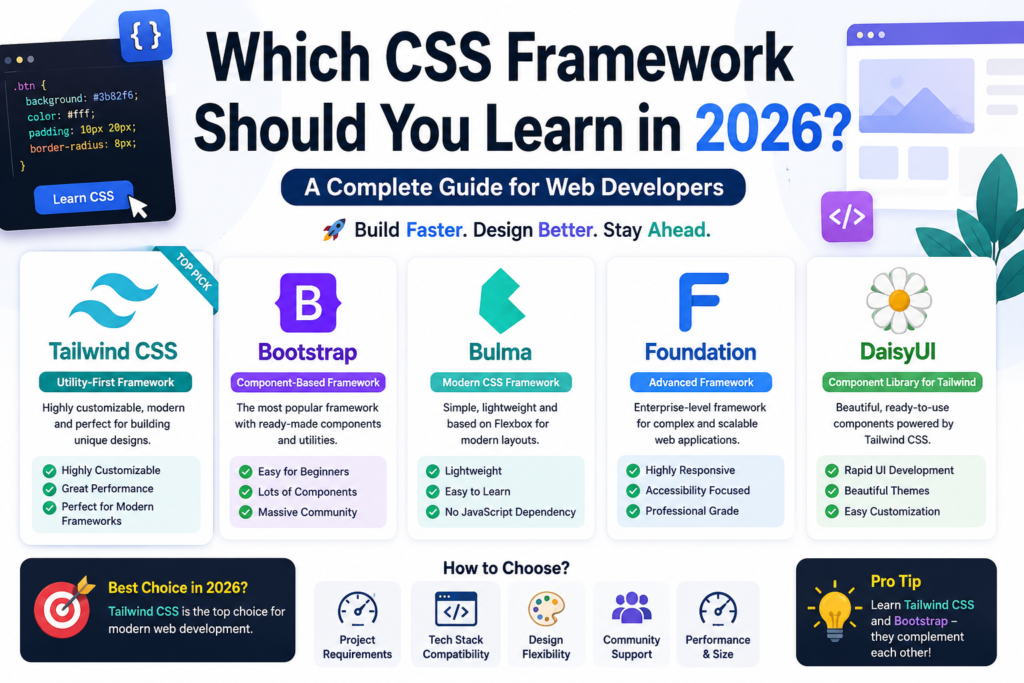



The world of web development evolves rapidly, and CSS frameworks continue to play a major role in building modern, responsive, and visually appealing websites. As we move into 2026, developers have more choices than ever before. From traditional frameworks like Bootstrap to utility-first solutions like Tailwind CSS, selecting the right framework can significantly impact your productivity and career growth.
If you’re a beginner wondering where to start or an experienced developer looking to stay relevant, this guide will help you choose the best CSS framework to learn in 2026.
Why Learn a CSS Framework?
Before diving into the frameworks, let’s understand why they matter.
A CSS framework helps developers:
- Build websites faster
- Create responsive layouts easily
- Maintain consistent designs
- Reduce repetitive coding
- Improve development efficiency
- Follow modern design standards
Instead of writing thousands of lines of CSS from scratch, developers can leverage pre-built components and utility classes.
1. Tailwind CSS – The Best CSS Framework to Learn in 2026
What is Tailwind CSS?
Tailwind CSS is a utility-first CSS framework that allows developers to build custom designs directly in HTML using utility classes.
Example:
<button class="bg-blue-600 text-white px-4 py-2 rounded-lg">
  Click Me
</button>
Instead of writing custom CSS, you style elements using predefined classes.
Why Tailwind CSS Dominates in 2026
Faster Development
Developers can create complex interfaces without constantly switching between HTML and CSS files.
Highly Customizable
Unlike traditional frameworks, Tailwind doesn’t force a specific design style.
Perfect for Modern Frameworks
Tailwind works exceptionally well with:
- React
- Next.js
- Vue.js
- Nuxt.js
- Laravel
- Astro
Better Performance
Unused CSS can be removed automatically, resulting in smaller file sizes and faster websites.
Pros
- Extremely flexible
- Modern design approach
- Excellent documentation
- Huge community support
- Great performance
Cons
- Initial learning curve
- HTML can become crowded with classes
Who Should Learn Tailwind CSS?
- Frontend developers
- React developers
- Freelancers
- Startup developers
- SaaS builders
Verdict
If you’re learning only one CSS framework in 2026, Tailwind CSS should be your top choice.
2. Bootstrap – Still Relevant in 2026
What is Bootstrap?
Bootstrap is the world’s most popular component-based CSS framework.
It includes ready-made:
- Buttons
- Forms
- Navigation bars
- Cards
- Modals
- Grid layouts
Why Bootstrap Remains Popular
Despite Tailwind’s rise, Bootstrap is still widely used in:
- Corporate websites
- Government portals
- Admin dashboards
- Legacy projects
- WordPress themes
Pros
- Easy for beginners
- Massive community
- Tons of templates
- Fast prototyping
Cons
- Websites often look similar
- Less design flexibility
Who Should Learn Bootstrap?
- Beginners
- WordPress developers
- PHP developers
- Freelancers working with clients
Verdict
Bootstrap remains one of the safest frameworks to learn because millions of websites still use it.
3. Bulma CSS
What is Bulma?
Bulma is a lightweight, modern CSS framework based on Flexbox.
It provides a clean and simple syntax without JavaScript dependencies.
Pros
- Easy to learn
- Lightweight
- Modern architecture
Cons
- Smaller ecosystem
- Fewer third-party resources
Verdict
A good alternative for developers who want something simpler than Bootstrap.
4. Foundation
Foundation is an advanced responsive framework often used in enterprise-level projects.
Pros
- Highly responsive
- Professional-grade tools
- Accessibility-focused
Cons
- Steeper learning curve
- Smaller community
Verdict
Useful for large-scale professional applications.
5. DaisyUI
DaisyUI is a component library built on top of Tailwind CSS.
It provides ready-made components while keeping Tailwind’s flexibility.
Why Developers Love DaisyUI
- Rapid UI development
- Beautiful default themes
- Easy customization
Best For
- SaaS applications
- Admin dashboards
- Startup projects
CSS Framework Popularity Trend in 2026
Based on industry trends and developer adoption:
- Tailwind CSS
- Bootstrap
- DaisyUI
- Bulma
- Foundation
Tailwind CSS continues to dominate modern frontend development, especially in React and Next.js ecosystems.
Which Framework Should Beginners Learn?
If You’re Completely New
Start with:
- HTML
- CSS
- Bootstrap
Then move to:
- Tailwind CSS
This path helps you understand both traditional and modern styling approaches.
Which Framework Is Best for Freelancers?
Freelancers often need to deliver projects quickly.
Recommended:
- Bootstrap for client websites
- Tailwind CSS for custom designs
- DaisyUI for rapid development
Which Framework Is Best for Jobs in 2026?
Employers increasingly seek developers with experience in:
- Tailwind CSS
- React
- Next.js
Learning Tailwind alongside modern JavaScript frameworks can significantly improve job opportunities.
Learning Roadmap for 2026
Month 1
- HTML5
- CSS3
- Responsive Design
Month 2
- Bootstrap 5
Month 3
- Tailwind CSS
Month 4
- JavaScript
Month 5
- React
Month 6
- Next.js + Tailwind CSS
Following this roadmap prepares you for modern frontend development roles.
Final Thoughts
Choosing the right CSS framework in 2026 depends on your goals. However, if you’re looking for the most future-proof option, Tailwind CSS stands out as the clear winner. Its flexibility, performance, and strong integration with modern frontend technologies make it the preferred choice for developers worldwide.
That said, Bootstrap remains valuable for beginners and professionals working on traditional web projects. Learning both Tailwind CSS and Bootstrap can provide a strong foundation and make you a versatile developer.
Quick Recommendation
- Best Overall: Tailwind CSS
- Best for Beginners: Bootstrap
- Best for React Developers: Tailwind CSS
- Best for Freelancers: Tailwind CSS + Bootstrap
- Best for Fast UI Development: DaisyUI
Invest your time wisely, keep building projects, and you’ll be well-prepared for the future of web development in 2026 and beyond.
